Friday, August 24, 2012

Spotlight On: Gardening Myth #3


Strange's is back on the case!  We have another myth to investigate and report on, so read on...

Today's Myth: Does adding chewing gum to a mole hole get rid of them?

The claim: Throw chewing gum down the mole hole and the mole will eat it, clogging their intestines before killing them.


Well, the consensus is....this is false!  Well, sort of.  While it's an interesting idea in theory, the problem is that there's no evidence that this has or will work.  Moles usually go after living insects and worms, and some say that they are unlikely to start chewing gum.  For the same reason, baits such as poison peanuts would not work.

However, there are others who claim that the gum trick will work.  One method is to shake up a few pieces of gum with some earthworms so that they are covered with the wormy smell, thus attracting the mole more easily.  Others claim that throwing the gum, wrapper and all, does the trick to trip up moles and gophers.

In the end, both the University of Florida and Ohio State University state that this method is not proven in scientific tests.  While you can try it at your own peril, the most effective method of control is setting a trap in an active tunnel, which many claim is your only surefire way to stop moles from destroying your lawn.

Tuesday, August 21, 2012

How to: Preserve Your Herbs

As summer winds down and we refocus our minds on Fall gardening, we must still remember to take care of our summer plants so that they are utilized to their completion.  Late summer, as we are in now, is a great time to harvest and preserve herbs you have out in the garden.  Cool weather and shorter days approach, a forecast that herbs don't generally benefit from, so its beneficial to pick your herbs within the next few weeks.  Preserving them will make their flavor last throughout the year -- what's better than using fresh seasonings grown by your own hand?  We will focus on two ways of preserving herbs -- air drying and freezing.

Herbs best for air drying don't  have a high moisture content, so focus on your bay, dill, marjoram, oregano, rosemary, summer savory and thyme for this procedure.

Cut healthy branches from your herb plant and remove any dry or diseased leaves.  Shake to ensure there are no bugs on your branches.  If you must, rinse off herbs with cool water, making sure to dry completely. Wet herbs will mold and begin to rot.

Remove the lower leaves on the last inch of the branch, and bundle several (4-6) branches together, tying at the stem where leaves were removed.  Cut a few holes into a paper bag and place the herb bundle upside down in the bag.  Gather the ends of the bag around the bundle and tie closed.  Make sure herbs are not crowded and hang in a warm and airy room.  Check on every couple of weeks until dried.

Can be stored up to a year in a zip-locked plastic bag or other airtight container.

For herbs with a higher water content, like basil, chives, lemon balm, mint and tarragon, it is not recommended to use the air drying process because they will most likely mold before reaching the dried herb stage.  Instead, try freezing the leaves individually.

Lay herb leaves flat on a cookie sheet and freeze.  Once frozen, move individual leaves to an airtight container and keep in freezer.  Doing it this way will prevent the leaves from freezing together.

Another way to enjoy herbs year round is to create your own kitchen herb garden.  Place pots near a south or east-facing window, and invest in a grow light during the colder months.

Tuesday, August 14, 2012

Spotlight On: Gardening Myth #2


Strange's is back on the case!  We have another myth to investigate and report on, so read on...


Today's Myth: Does yellow clothing attract flying insects like bees & mosquitoes?

The claim:  Wearing yellow clothing outdoors attracts mosquitoes and bees to your body, resulting in unwanted bites and stings.

Well, the consensus is....this is false!  Yellow will not attract flying insects to you specifically, and may even help to deter them.  Insects are attracted to ultraviolet and blue light, including black and florescent.  Yellow lights or the color yellow can actually help prevent mosquitoes from biting you, because yellow is a color they can hardly see and when they do see, the color confuses them.  Mosquitoes use heat as one way to locate their victims.  The possibility of mosquitoes attacking is also less likely when you wear light-colored clothing, like white and yellow, because light colors have a tendency to reflect heat.  Darker color clothing, like navy blue and black, tend to absorb heat from the sun and therefore would be more likely to attract a mosquito.  Light, not bright, colors also repel bees.  

Other ways to avoid mosquito bites would be wearing bold patterns, since dark solid colors are easier to spot.  Mosquitoes are also drawn to certain odors, perspiration being one of them, so wearing loose, cotton clothing will more likely protect you than wearing something that makes you sweat.

Of course, these aren't foolproof ways to avoid getting bit by mosquitoes, and we suggest investing in one of the great many products Strange's carries to repel flying insects that bite.  

Tuesday, August 7, 2012

Spotlight On: Garden Myths

Ever heard a gardening myth and wondered if it was true?
Gardening myths have always been around, and with the arrival of the Internet, have been shared from around the world, making it hard to sift through what works and what doesn't. Gardeners want what's best for their plants, which is why we are always trying to find the organic and natural way to lush green foliage, health, longevity, and big, beautiful blooms.

 Here at Strange's, we are ready to crack the myths. This is the first of hopefully many blog entries highlighting a certain myth that you may have wondered (and hoped!) was true.


Today's Myth: Does Epsom salt help roses and other plants grow?

The claim: Add a few tablespoons of Epsom salt to the soil around your roses, vegetable plants, and houseplants for more blooms, fruit and healthier foliage.


Well, the consensus is....it does!  Epsom salt is composed almost exclusively of Magnesium Sulfate, two minerals that are crucial to healthy plant life.  The Magnesium is beneficial to plants at the beginning, as the seeds begin to develop.  It infuses with the seed, strengthening plant cell walls.  Magnesium also assists with the creation of chlorophyll, as well as helps the plant to soak up phosphorus and nitrogen, which serve as vital fertilizer components in the soil.  Magnesium is believed to help with increasing the amount of fruit or blooms on your plant.
Sulfate aides in the production of chlorophyll, improving the health and longevity of the plant.  It joins with the soil to make nutrients more effective for your plants, including nitrogen, phosphorus and potassium.  

Specifically, how do you use it?  It varies from plant to plant, but for roses, for example, before planting, throw in 1 Tb. of Epsom salt into the hole before placing the rose bush.  If your roses are already planted, water with 1 Tb. of Epsom salt dissolved into 1 gallon of water.  For flowering and green shrubs, work in 1 Tb. of Epsom salt per nine square feet of bush into the soil over the roots.  For tomatoes, create the same water and Epsom salt mixture listed above and water every two weeks with said mixture.  For potted plants, dissolve 2 Tb. of Epsom salt into 1 gallon of water and water at least once a month.

Epsom salt sounds like a great product that every gardener should have -- who knew?  I guess we'll be finding out all sorts of neat gardening secrets, so until next time!  Is there a gardening myth you want Strange's to prove right or wrong?  Drop us an email at marketing@stranges.com and it could be our next topic!

Monday, July 23, 2012

New for Spring 2013

The Everlasting Series of Hydrangeas
Better than re-blooming, they're Everlasting!


Everlasting Revolution

Introducing the Everlasting Series of Hydrangeas, a tough new line of Hydrangea macrophylla bred specifically for the cut flower market, giving them amazingly tough stems, thick, leathery foliage, and the strongest, longest lasting mop head blooms you've ever seen!
Think of the series as a fairytale-like journey, starting with various shades of green and aging to multiple shades of green, pink, purple, blue and red and then finally back to green with a hint of the previous color. Not only are the mélange of colors gorgeous and eye-catching in the garden, but these hydrangeas were bred to be sturdy and well branched, making them the perfect pot crop for the gift plant market.  Cold hardy to Zone 5, they will also do well in the garden, and are excellent as a cut flower.  Each stem is a bouquet, and gardeners will love the mop heads of the Everlasting Series with their variety of colors, handsome foliage, and sturdy habits.

This new series of hydrangeas prefers full sun to partial shade, and will grow to be 3-4 feet tall and wide.  Blooming through May and June, these everlasting beauties will overwinter in Zones 5 through 9 for gorgeous blooms year after year.


Everlasting Amethyst

Everlasting Harmony


Everlasting Opal

Everlasting Garnet

Tuesday, June 5, 2012

Prepare Yourself

It all starts around this time. The Japanese Beetles emerge from a warmed soil and begin to hunt for food. It is not long before they mate and the female burrows into the soil and lays her eggs. Forty to sixty eggs in her lifetime! These developing beetles then spend the next 10 months in the soil as white grubs. These grubs feed on the roots of turfgrasses and vegetable seedlings, surviving in any soil in which plants can live. As these grubs chew off the roots, they reduce the ability of the grass to take up enough water to withstand the stresses of hot and dry weather, resulting in large, dead patches. As the grubs destroy your lawn, the mature beetles feed on over 300 species of plants, devouring leaves, flowers and overripe or wounded fruit. A tree that has been severely damaged by Japanese Beetles appears to have been scorched by fire.

One of the most devastating pests of urban landscapes in the United States, Japanese Beetles are a force to be reckoned with. Traveling and eating in groups, they do the most damage. The beetles are most active on warm, sunny days and prefer plants in direct sunlight. When laying eggs, the female beetle seeks out moist, grassy areas, as adequate moisture is needed to keep eggs and newly-hatched grubs from drying out. Excessive rainfall or heavy watering of lawns does not bother them. June is the month they descend upon us, as adults emerge from the soil and begin feeding on plants. It is most intense over a 4 to 6 week period beginning in late June, after which the terrorizing beetles gradually die off.

Now is the time to prepare yourself.  Though it has begun, we have time to stop them from destroying our gardens.  At Strange's, our mission is your gardening success and we mean it.  We want you to arm yourself, and not give up without a fight.  You've worked too hard on that pristine lawn and perfectly healthy garden to let the Japanese Beetle win.  Below we share a few products you can find at Strange's that will put the odds in your favor.


Sevin Ready-To-Use: This ready-to-use liquid bug killer is designed to kill over 100 insects, including Japanese Beetles.  It provides excellent control of leaf eating and sucking insects.  This spray does not require any mixing and is perfect for spot applications on your outdoor flowers, fruiting plants, and vegetable gardens.

Captain Jack's Deadbug Brew: This product contains Spinosad, a naturally occurring soil dwelling bacterium.  This makes Captain Jack's an organic pesticide and safe to use for indoor gardening.  It targets a multitude of insects, including the Japanese Beetle.  This product may be applied directly from the container.
Safer Brand Japanese Beetle Trap: This trap uses a food and sex attractant to lure insects into the trap and disrupt the mating cycle.  A controlled release system maximizes the life of the attractant and protects it from environmental degradation.  Place this natural pest control trap at least 10 feet away from plantings to prevent defoliation.

Monday, May 28, 2012

A fighting chance for this old Crab Apple

We recently had a really good question on Facebook from our Customer Chris concerning his large Crab Apple tree.  He has graciously allowed us to repost important parts of the conversation and photos for all to learn from.

"I have a HUGE crabapple tree (about 25' tall and about 30-35 wide) that is beautiful when it blooms in the spring and is perfect shade tree for the patio that it grows over. Unfortunately, every year around this time the leaves begin to develop brown spots, start to yellow, and fall off (the foliage is very dense until this point). I have tried spraying it with neem oil per one of your employee's recommendation, but that to no avail.

I recently tried introducing ladybugs to it that I bought from you, thinking it might be spider aphids, so hopefully that will help somewhat.

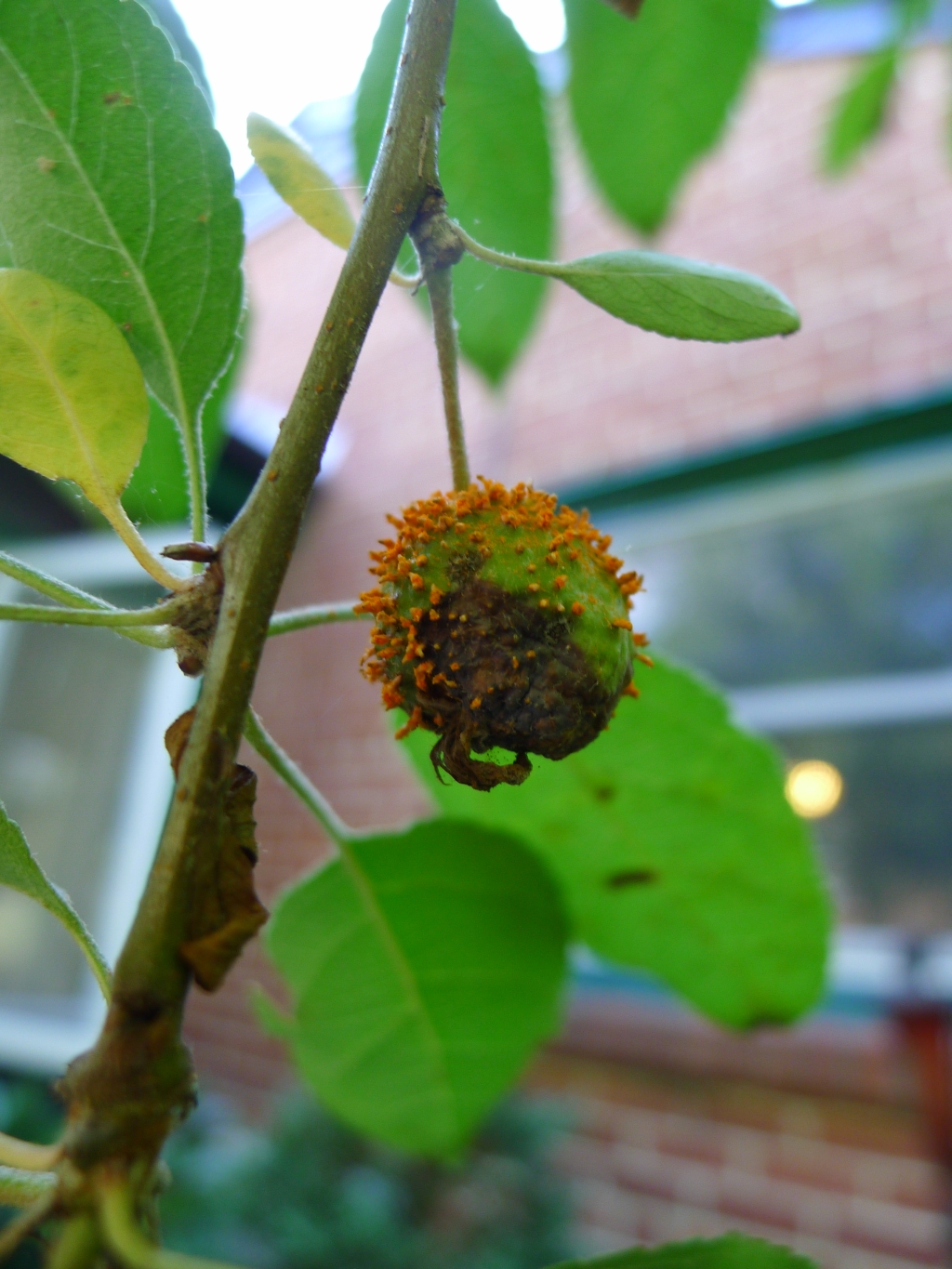
At this rate, 80% of the leaves will be gone by late August. Of note, around this time of year, it develops a growth that comes out of a hole where a limb was cut off a very long time ago (see picture included).

It looks and feels like fungus of some sort and drips sap out the bottom of the hole. I have also noticed when pruning some branches that were about one inch thick, that there was a redish/dark brown ring about 1/8 of an inch below the surface. This series of events started abruptly one summer about 4 years ago.

I love this tree and would hate to see it die, but I understand crabapple trees can be finicky (especially when they are 20+ years old). If I could keep it the way it looks for the first few months during the spring I'd be a happy camper. Any advice you might have would be greatly appreciated. Thanks for all your help with my garden this year, the rest of it looks great!"

He attached some photos:


The folks in the nursery think that this is a systemic (whole tree) fungal infection.  Generally the only way to take care of this is to use a whole-tree systemic spray as well as fertilize the tree to give it a fighting chance.    To be on the safe side though, we recommended Chris contact Joel Koci, an Arborist with Arborcare in Rockville, VA.

Chris is going to keep us posted on the happenings of this awesome Crab Apple and we are rooting for a win! (pun intended) 

If you have specific questions, please do shoot us a message on Facebook or email info@stranges.com and we will gladly help.  Detailed photo's like Chris' are a plus for both the assessment and as an example for other gardeners in and around Richmond.